Tuesday, 6 March 2012

The City of Wine

Mendoza, the city of wine, where grapes grow by the roadside and even the fountains flow with wine....


Our visit to Mendoza coincided with the cities Fiesta Nacional de la Vendimia, the grape harvest festival. Mendoza as a city is beautifully done, with several large plazas, wide tree lined avenues and of course plenty of very cheap but good quality wine. There's a huge stunning park on outskirts of town and it's definitely a place where you could potentially spend a prolonged amount of time.

Whilst in town we thought we'd take advantage of free flowing Rio Mendoza, and go for a ride down the rapids. After a 10 minute tuition on what to do when (and not if) you fall out the raft we were on our way. It was grade 3 rapids, meaning no inherent risk of injury but some adrenaline rushes and some big drops. After a good soaking and a few strong rapids, we decided to take a few backwards. It's probably easier as you don't see what's coming and don't get a wave in the face but the drops can be quite unexpected. After about an hour and a half, 18km or so, we made it to our destination, all still safely in the boat but absolutely soaked through!


After the rigours of the river it was time to enjoy Mendozas primary attraction. The following day we caught the local bus to Maipu, a wine region of around 20 bodegas. From here we took a couple of bikes and spent the day visiting several of the wineries, doing the tour and then trying what they had to offer. After all ready learning how to taste a wine properly we learnt a lot about the wine making process; grape selection, barrel and fermentation time, and ageing aswell as the different grape types, especially the Malbec which is Mendozas prime grape. After a full days riding and drinking in the sun we slowly and slightly wobbly made our way back with the bikes.


The following morning and in a bid to ease our hangovers we visited the nearby Cacheuta thermal springs. The hot springs have been made into a nice park with a good amount of space so you can enjoy pools of different temperatures, and even float round in a lazy river. The skies were blue, the sun was shining and the temperature was around 32°c so you didn't really need to spend too long in a hot pool before jumping into some nice cold water.


When we got back from the springs Mendoza was getting ready to party. Friday night was the Vía Blance de las Reinas, essentially a beauty pageant where the girls from each department in the province of Mendoza are paraded around the streets on floats. This started around 11pm and went on for several hours finishing with live music in the large Plaza Independencia.

The following day was the Carrusel Vendimial, where the ladies were out on their floats again, this time throwing out grapes, apples, and even the odd (dangerous flying) melon. One of the guys we met wasn't paying enough attention and took a rogue apple in the eye! After the ladies, the guys followed with around a hundred gauchos on horseback parading through the streets. Evidently it makes sense to let the beauty pageant contestants go first, as 100 men on horses can leave quite a stink!


The Vendimia festival was great fun, and good timing for us. It was a great way to see out our last stay in Argentina, before making our way back to Chile and our flight out of South America.

Saturday, 3 March 2012

Viña & Valpa

From Pucon we made our way north on the overnight bus (8pm-8am) to the Pacific coast city of Valparaiso. Situated 120km north west of Santiago is a city quite literally steeped in history and culture, that sits on top of 47 different hills.

Due to the number and gradient of these hills, the town is scattered with funiculars, 13 in total, however due to political issues and part privatisation only half were in service whilst we were there, which seemed to be the norm. The town is a Unesco World Heritage site, partly due to the hills and funiculars, but also because of the houses, which are covered with corrugated iron and then brightly painted in unique colours.


We arrived in Valparaiso pretty tired from the overnight bus, and got to our hostel even more so after climbing the 200 odd steps up the Cerro Bellavista in the morning sun. The hostel was nice and the staff just as much, as they brought us some cold water and told us to sit down and have some breakfast - we must have looked a right state!

As we needed to wait for the dorm to be cleaned we decided to head in to town and do a free walking tour. The tour was a small group of about ten and was run by a local Valparaisen. It was around three hours and was a good way to the see and understand the city from a local perspective.

Like the houses the city is very bright and vibrant and a lot of the walls are commissioned street art, and those that aren't are covered in it anyway. Our tour showed us some of the best pieces, a ride up one of the funiculars to Cerro Concepion, a trip on one of the trolley buses and finished with a Pisco Sour. Alll Chileans claim their variant of the cocktail to be the original and better than Peru's version. From our experience we would be inclined to agree, very good but very strong.


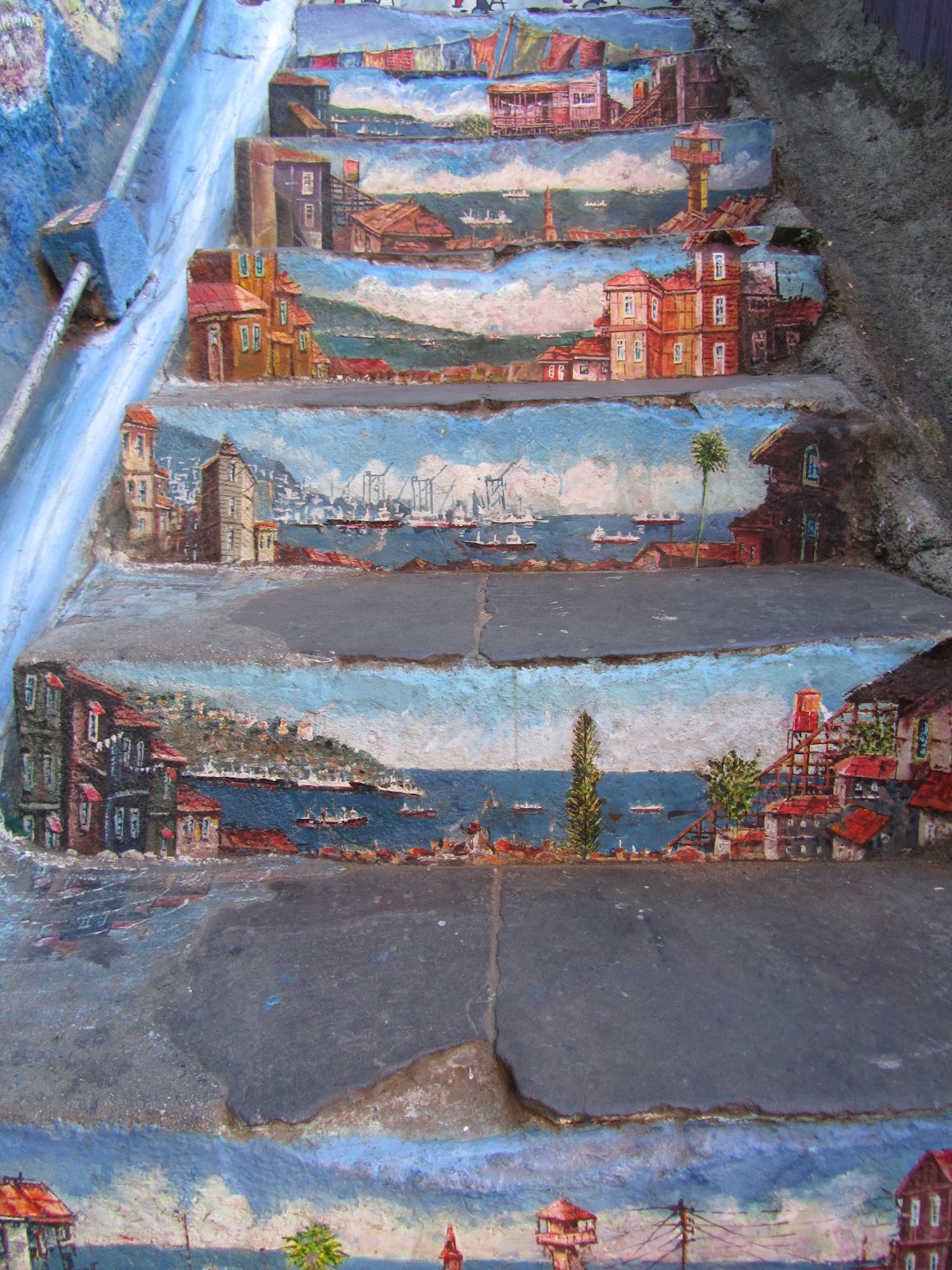
Our hostel was on top of the Cerro Bellavista which is also home to the open air street art museum where a lot of the walls and more interestingly all of the steps are intricately painted.


After a couple of days of appreciating what Valparaiso had to offer we took a trip to nearby Viña del Mar. For a city just 9km further down the coast the differences couldn't be more apparent. Viña is a very new city with large shopping malls, clean streets, luxury hotels and apartments and miles of beach. This is in complete contrast to the rustic and historical significance implored down the road in Valparaiso.


After four nights in Valparaiso it was time to make a final foray into Argentina with another over night bus to Mendoza....

Sunday, 26 February 2012

Tinquilco Tranquilo

Whilst in Pucon and in a vain attempt to recover from the rigours of the Villarrica Volcano we made our way to the Parque Nacional Huerquehue. We had three nights booked at the beautiful Refugio Tinquilco for some much needed R&R.


As the Refugio is in the national park we only brought food for lunch and thought we would spoil ourselves for a few days with someone else's home cooking. An idea that paid dividends as we gorged on Asado Lamb, Chilean Paella and dressed Salmon. The refuge which is more of a lodge was built by the owner, Patricio, some 20 years earlier. It can accommodate only 14 guests but is a stunning home inside and out with large grounds including a forest sauna and access to a beach on the lake. Whilst here we did a couple of hikes up into the mountains, one seven hour leg stretcher that encompassed around eight different lakes and some fantastic views. The other a shorter but more strenuous trek which involved walking up 800m altitude in little over an hour. At the top however were some rewarding views of the surrounding volcano dotted landscape. The National Park is home to a multitude of flora and fauna, most famously the funky Monkey Puzzle Tree. Along with a lot of unidentifiable wildlife we also saw a snake, parrots, woodpeckers an untold amount of lizards and even a rogue cow halfway up the mountain trail.


In the evenings after dinner Patricio would bring out the guitar alongside a varied collection of other instruments. There was always a good eclectic assortment of music being played until the early hours amongst Patricio, his sons and whoever else fancied a go. We even got to witness firsthand some authentic Chilean dance alongside some live 'Panpipes of the Andes'.

It was a nice change of pace from the swarms of Chilean summer tourists who visit Pucon in February. Back in town we had spent our time enjoying the weather whilst we could down on the beach or a small park in front of the marina. The town centre is quite small but heavily geared for an influx of summer tourism with arty markets and nice restaurants.


We now leave to head north towards the wine regions of Chile and Mendoza, which should bring a relatively welcome break to all the hiking...

Thursday, 23 February 2012

Volcano Villarica

As we approached Pucon on the bus we started to appreciate the task laid out in front of us.... Volcano Villarrica.

More than one hour before arriving in Pucon the Villarrica looms ominously on the skyline, a near perfect triangle. The volcano is one of the ten most active in the world, and on nearing Pucon clouds of grey were clearly visible spewing out from the top. The volcano is layered with snow, ice, black volcanic rock and cloud.


With the aim of summiting the Villarrica in a day we signed up for a 4.30am start. The previous evening required a small induction and fitting of the mountaineering gear required. A short nights sleep filled with anticipation and fear had us waking at 3.45am and kitting ourselves out in mountain boots and overalls, as well as picking up the rest of the required gear; helmet, headlight, iceaxe and crampons.

A short drive to the national park and the base of the volcano had us walking and setting off from the bottom at around 5.30am. A slow start and we were playing catch up as Adam had to do a Paula Radcliffe half way up the mountain. After an hour and a halves climb up the volcanic rock, at a speed of two steps forward one step back, as you slide back down the loose rock, dawn was breaking and the flash lights could come off the head. A welcome relief as one of ours had already died a half hour previous!


From here we were told it was to get difficult and the helmet was now mandatory. We entered the cloud and all visibility dropped to a minimum. If you dropped more than 10 meters behind the guide, you had no guide! A combination of perseverance and willpower had us climb uphill as far as possible through the cloud and across a small icefield before having to reevaluate our equipment.


On came the crampons, all and any additional items of clothing, two pairs of gloves and the pickaxe in hand. From here it was ice and snow and lots of it! The temperature was well below freezing and the moisture and wind in the cloud subtracted about another 10°c. The 10 meters of visibility we had earlier felt like a mile as the guide and the rest of the group disappeared five meters ahead and out of sight! The climb up the ice was difficult due to the weather but with the crampons on it was easier than climbing the volcanic rock earlier in the morning.

We had several painful stops on the way up, standing still on the ice in the cloud and clung to the side of the volcano in freezing winds is not a friendly experience, and with two pairs of gloves on you can forgot about being able to blow your nose! Our stops were to allow the guide to check the conditions ahead, and with one final push to the top we got some bad news... Conditions at the top were more severe and required a near vertical climb up loose falling boulders. We had been defeated by Mother Nature. With just several hundred meters to go to we had no choice but to turn back. Reaching the summit would have gained us nothing due to the thick cloud and lack of visibility, whilst turning back would at least save us another hour of pain before the crater.


Heading down however proved no easy feat, descending a near 45 degree angle on the ice is a challenge. After falling twice, one requiring a heavy swing of the ice axe to hinder an infinitive slide down the glacier it was a welcome relief to get the crampons off and start making a more solid descent down the side of the volcano.

As we exited the cloud we had some great views of Pucon, the national park and the lake. From here it was clear that Pucon was basking in the sun, whilst we just a short distance away but more than a thousand meters higher were in a thick isolated volcano cloud!


Friday, 17 February 2012

Chillin in Chiloe

From the Argentinian Lake District we made our way South West over the Andes and into Chile. After a brief overnighter in the cruise port city of Puerto Montt we made our way the following morning to the mystical Isla de Grande Chiloe.


Chiloe has many myths and legendary characters created for various reasons by the original natives which still play a strong part in its modern day culture. Chiloe is also heavily influenced by the Spanish Jesuit Missionaries who built over 150 wooden churches on the island in an attempt to Christianise the then locals.


A bus-ferry-bus combination took us to the northern most town of Ancud. A pleasant town very dependent upon it's fishing industry. While here we thought we would do out part and contribute to the local economy. We had clams and fresh fish in the restaurant, and took home oysters and mussels from the market for homemade moule frites. A kilo of mussels will set you back 500 CLP (66p), but you do have to scrape the barnacles off yourself!


Whilst on the island we took the local bus to a beach on the Pacific side of the island which houses four penguin colonies. From the beach we took a short boat ride around the rocky islands to see the colonies of Magallen Penguins, as well as some cormorants and a couple of sea otters.


After the boat we grabbed a bite to eat at the restaurant on the beach and had our largest empanadas yet in South America! Whilst waiting at the bus stop we were lucky enough to see some dolphins as well, frolicking in the water and racing the waves.

Chiloe is the largest island in South America, (about 250 km long and 70km wide) therefore the wooden churches are all very spread out. We saw only a couple but saw wooden (obviously) models of the most interesting ones at the museum. It explains the carpentry and intricate wood joins used in construction which is just as interesting as the church's themselves. As well as the churches the island is scattered with forts, as it was the last Spanish outpost in South America.


Whilst on the island we also took a trip down to the capital, Castro. The town is famous for it's Palafitos, wooden houses built on stilts protruding into the ocean. They are quite an interesting concept, however a lot of the bright colouring of them has started to fade now.


February is a big month in Chiloe and they have events going on nearly every day. Whilst we were there we saw numerous markets and events in the main Plaza Del Armas, and on our last day we even witnessed a Chiloen Electronic Outdoor Rave... ish.

Monday, 6 February 2012

The ´Holy´ Lake District

It seems your nobody around here unless you've reached full martyrdom status. With that in mind we spent the week in San Carlos De Bariloche and San Martin de Los Andes. This really marks the end of our journey through Patagonia as we find ourselves in the heart of the Argentinian Lake District, and it's really not hard to see where this name comes from!

We started with Bariloche and arrived on a surprisingly wet and windy afternoon. This wet weather set the scene for the rest of the afternoon and most of the following day. It did however give us a chance to catch up on a bit of reading and planning for the next few weeks.

Once the rain had let up we set off in to town to see what all the fuss is about. Bariloche is another of those two season cities, frequented in the winter for skiing and summer for the outdoor activites. The centre is dominated by chocolate shops and outdoor clothing stores. The city is quite heavily Swiss dominated and it shows in the wood and stone chalet styled buildings, chocolatries and restaurants serving fondue.


After a couple of nights in town we left for the nearby national park and the heights of the Cerro Frey. With sleeping bags and some food stashed in our packs we set out for the very modest Refugio Frey. A tiring hike up the mountain saw us detour to the playa on Lago Guitterez and climb over 1,200m in altitude. On the way up we encountered another long abandoned refuge built under a huge rock, and hoped that ours would be a bit more stable and at the very least be able to accommodate us!

A steep scramble for the last hour or so put the refuge in sight, with just one more obstacle.... The previous days rains had left the small fjord a little more treacherous than usual.


With some careful steps and the waterproof hiking boots paying for themselves we arrived at Refugio Frey. The refuge is about the size of a small detached house, with a kitchen and some tables downstairs and the upstairs littered with mattresses on the floor, and more on a second 'shelf' as oppose to any actual beds. Still it was quaint enough even if on arrival we found out we would be bunking down with 15 burly military men out on a training exercise. All in all there must have been about 30 people crammed around three tables in the warmth of the refuge, and then 20 of us later trying to the sleep on the cold second floor! By cold it was full clothing layers and hat on before wrapping up in the sleeping bag.


The following day we hiked back down and spent the day relaxing in Bariloche, enjoying the lake and chocolates on offer. A warm and relaxing afternoon after the almost sub zero temperatures of that night. Bariloche itself is spread along the Nahuel Huapi Lake and the next day we took the bus 25km along the lake to the Llao Llao Municipal Park. More of a stroll in the park than a hike in the mountain had us taking in the greenery and seeing yet more lakes!


In June 2010 a volcano several hundred kilometers away across the border in Chile started spewing ash into the sky and the Pacific winds have been bringing it Bariloches way ever since. We've met people along the way who have been to Bariloche to find the place coated in a thin layer of ash. For us however it had no real effect. The exception being the day we left when the ash created a haze in the sky that made it impossible to see across the lake and restricted visibility to what looked like a cold winters morning fog.

Leaving the ash behind we made our way north to the small quaint town of San Martin de Los Andes. The town is situated on one end of the Lácar Lake with a small beach. You can however see less than 5% of the lake from the town so we took a short walk up to the local Mapuche village for some stunning views of the rest of the lake and San Martin. A very nice and small town that was celebrating it's anniversary (Feb 4th) on the day we were there with a triathlon for the men (and a few brave women) and a small fiesta in the plaza.


Friday, 3 February 2012

Small Trains, Welsh Settlements & Hippie Convents

After the rigours of the Ruta 40 we arrived at our next destination, Esquel.  Esquel is a popular destination with Argentinian tourists in winter for skiing and summer for hiking.

After the summer heat of Southern Patagonia the sun in Esquel was even more demanding. The mornings start cool but late afternoon the sun gives off powerful rays that always seem to be beating down on the back of your neck regardless of which direction your walking.

On our first day we took a trip across town to visit the Patagonian Express train, also known as 'La Trochita'. Unlike Europe, trains are a relatively rare sight in South America, and a lot exist only as part of the old freight networks. La Trochita still runs but only as a tourist train and is famous for and takes it's name (La Trochita means Little Narrow Gauge) from it's very narrow track. The track is just 75cm wide, so the train appears to sit very top heavy on the track, a suprising design considering the strength of the Patagonian winds.


The following day we took a trip to the nearby Welsh settlement of Trevelin. Although pleasant enough Trevelin doesn't really provide much other than a few Welsh flags and some quaint tea houses. Although in hindsight not sure what more you could expect from a foreign settlement whose home country is famous for leeks, sheep and Ryan Giggs (in the most respectful way).

On our final day in Esquel we took a short hike to a nearby Laguna which offered a pleasant place for some piece and quiet and a picnic. In fact on our way there we hardly saw another person.


The following day we set off for Argentina's 'hippy' city, El Bolson. Although heavily populated by hippies from Buenos Aires in the 70s the town is very laid back and commerce is centred around homemade breads and jams, and hand carved wooden intricacies. We stayed in a great hostel outside of town which had lazy hammocks outside for the hot days and a roaring fire inside for the cool evenings. Whilst at the hostel we had a wine tasting night for 40 pesos (£6) and had a long evening learning about and trying wines from Mendoza and Patagonia.


During the days in El Bolson we hiked the six hour return trail to the Cajon Del Azul. Several Indiana Jones style bridges and 10km or so later brought us to some stunning natural rock pools for swimming. The water however beautiful to look at is chilled to an incredibly fresh single digit temperature.


 A trip to El Bolson also requires visiting the thrice weekly artisenal market, browsing only for us, except for the produce side which included a raspberry, cream and dulce de leche topped waffle!


Not exactly what we would call 'hippie', if the term truly exists in the 21st century but a relaxed town with a young, fresh and relaxed feel.